Monday, 25 March 2013

Stuffed aubergines with two color rice and Detox juice


  All seasons feed our imagination with their peculiar charms but by this time, with the arrival of my favorite season, the charm of the birds and of the plants inspires me in a special way.
  Spring also brings more vegetable varieties and a greater diversity of options for making delicious dishes, producing the energy and creating a proper atmosphere to experience healthy meals.
  To reduce (or to eliminate) the consumption  of animal and dairy products, increasing the eating of raw vegetables and green juices, helps us to strengthen our immune system that, at this time of the year, can be more sensitive.
  To celebrate the first Sunday of the season I prepared a detox juice and a dish based on  aubergines and rice.
  A few days ago I had this desire of eating aubergines and when I found these on sale, I bought them! Stuffed with seitan and white sauce, served with two color rice and a green salad, they were delicious!


Ingredients for the juice:

2 medium carrots
2 small oranges
2 small beetroots
1 slice of ginger
1 slice of lemon


Drink it with empty stomach and after 20 minutes, if necessary, eat something healthy.

Ingredients for the meal:
(Serves 4 people)

4 aubergines average size
200 g of seitan
1 onion
3 garlic gloves
1 bay leaf
4 medium tomatoes
3 tbsp olive oil
1 dl vegetable broth
1 tsp of cinnamon powder
breadcrumbs
salt


For the white sauce:

1.5 dl of oat milk *
40 g of vegetable butter (I used vitaquell)
25 g of whole flour
pinch of salt
pinch of nutmeg

* I used what I had done: 150 g of oat flakes, hydrated in mineral water overnight. After that, they were drained and rinsed under running water and then blended with 150 ml of mineral water and a pinch of salt. When I got the consistency I wanted, I strained and squeezed all the liquid to get the milk.

For the rice:

6 hands of basmati rice
1 beet


Start by washing the rice and place it in a container with water to cover. Let it stand for 1 hour.

Wash the aubergines and cut them into two halves. Let them stand for 20 minutes while you begin to prepare the seitan.
Place the olive oil in a pan and heat. Add the onion, cut into quarters, let it brown and add the chopped garlic. Stir it well and add the peeled tomatoes. Let it ascertain for 5 minutes on medium heat and add the bay leaf and the seitan cut into cubes. Add the vegetable stock and simmer for 10 minutes while you remove the inside of the aubergines and cut the flesh into small pieces.
After 10 minutes, add the aubergines, season them with salt and cook for 5 minutes more. Add cinnamon and cook for 1 minute more. Remove it from the heat and blend until you get a creamy paste.

Preheat oven to 200 º

Begin to prepare the white sauce: place the butter in a saucepan, on low heat, to melt. Add the flour and stir quickly to engage fully. Add the milk and stir until thickened. Season it with salt and nutmeg.

Add the white sauce to the seitan paste, stuff the aubergines, sprinkle them with breadcrumbs and bake in the oven for 30 minutes.

Prepare the rice:

Cook 4 hands of rice in plenty of water and salt for 5 minutes. Drain and let it stand for 5 minutes.

Wash the beets, remove the peel and grate them . Put water in a pot and when it starts boiling, add the beets and simmer for 5 minutes. Add 2 hands of the remaining rice, season it with salt and cook for 8 minutes. Drain and let it stand.

Serve the aubergines with white and rose rice. Add a green salad.

Bon appétit!

© veggie delicious food, March 2013

Monday, 18 March 2013

Soba soup


          Trying a vegetarian diet can reserve very good surprises. Besides the benefits to human health, there are also many advantages for the health of the planet.
  A vegetarian meal has many possibilities in terms of flavors and textures, with plenty of alternatives for combining ingredients that have nothing in common with the ​​reducing idea that a vegetarian only eats "green stuff"
  It is known that water on the planet tends to decrease, mainly because of the unsustainable use of the natural resources. Forest destruction to create grazing pastures and livestock are two parallel industrialized agents with the same objective, that consume forest and water in an unsustainable and destructive ratio of natural resources in an irreversible process.

  My recipe suggestion for today is very simple to make and with easy found ingredients.
  I prepared a soba noodle soup.
  Japanese soba is a based buckwheat pasta. It is very tasty and when combined with vegetables and tofu is just super delicious...


Ingredients:
(Serves 4)

Soba pasta
350 gr pumpkin
5 large carrots
1 large onion
1 bunch of asparagus
200 g of mushrooms
150 g of tofu
2 tbsp olive oil
2 tbsp soy sauce
1 tsp lemon juice
salt to taste
Arugula for garnishing

Start by cutting the tofu into cubes and allow them to marinate for 20 minutes in 150 ml of water with the soy sauce and lemon juice, while you prepare the remaining ingredients.
Wash the carrots and pumpkin.

Cut into 100 gr pumpkin (without removing the skin) and 2 carrots into small pieces and reserve to use later.

Remove the peel of the onion, cut it into pieces and put in a pan with olive oil. Let it cook for 2 minutes over medium heat, stirring constantly to prevent from burning.
Add the 150 g pumpkin and 3 carrots cut into small pieces and cook it in water that covering all ingredients. Season it with salt and when the ingredients are soft, blend until you get a creamy puree.

Meanwhile, steam the pumpkin and the carrots that you have reserved until they are al-dente.

Clean the mushrooms and cut them into pieces.
Wash the asparagus and cut them into pieces.
After getting the pumpkin and carrots puree, add the soba pasta in the desired proportion. Separate the soba with a fork and cook it for 4 minutes.
After 4 minutes, add the tofu, the mushrooms and the asparagus.
Let it cook another 3 minutes and add a bit of marinade water of the tofu and the steamed pumpkin and the carrots as well.
Season it with salt and serve garnished with arugula.

Bon appétit!

© veggie delicious food, March 2013

Wednesday, 13 March 2013

Seitan with peanut sauce and quinoa


  Using peanuts as an ingredient to a seitan dish may be a non-appealing suggestion, especially for those who have never tried seitan, but it is just to challenge those who have never tasted this gluten basis product ( a wheat protein), that I invite you to try this dish.
  Seitan can be purchased in natural food stores or it can be home prepared and with the advantage of being cheaper.
  To produce seitan either wheat flour can be used ( a process that takes time), or gluten flour (quick version). Talking about proteins, seitan is an excellent meat substitute and it is very versatile for cooking. You can roast it, bread it, use it for pies, soups, and much more, just use your imagination. When well seasoned, it gets a delicious taste.
  However, if you are gluten intolerant, choose another protein suitable for you.
  Today's recipe is another palate appeal. I hope so!
  It is the result of combining seitan with peanut sauce and red quinoa.
  Quinoa is the grain taken from a plant which is found in Columbia, Peru and Chile. It is also known as “the golg grain” and it was widely used by the Incas and the Aztecas who were well aware of its benefits. Quinoa is a very reach cereal and easy to digest. It is gluten-free, rich in fiber, minerals and vitamins.
We can easily find two different varieties of these grains: white and red. Thereis also quinoa flour and flakes. You can use it in many dishes, such as cakes, pies, sauces, and even the most unpredictable ones!


Ingredients:
(serves 4)

Measure 4 hands of quinoa and soaked it for 4 hours
200g seitan
100g lombard leaves cut into stips
100g carrots cut into strips
1 tbsp cocont oil
1 medium onion
3 garlic gloves
1 cup peanut powder and 3 tbsp grossely smahed peanut
2 cups mineral water
2 tbsp soy sauce
salt to taste
some lemon drops


Soak quinoa for 4 hours and then cook it in salted water for 30 min, medium heat. When the germ stars getting white and soft, drain, cover it and let it stand for 5 minute.

Steam the lombard leaves until soft and do the same with the carrots.
Chop the onion and sauté in the coconut oil. When it turs golden, add the garlic andd let it cook for 1 minute on medium heat, stirring constantly. Then add the seitan cut into thi strips.
Combine well and let it cook for 5 minutes. Season it with salt.

For the peanut sauce: place the water in a pan, season it with salt, let it boli and then add the peanut powder. Combine well and add the soy sauce and a few drops of lemon. When you get the consistency that you want, turn of the heat and pour the sauce over the seitan.
Sprinkle it with the smashed peanuts.

Serve it with radish and alfafa.

Bon appétit!

© veggie delicious food, March 2013

Monday, 4 March 2013

Algae pasta with fava beans


Spring energy begins to manifest at this time. Proof of that is the appearance of some products in the market. I am referring specifically to fava beans, which although still small, already challenge our will to enjoy them.
   This Saturday, while doing my weekly shooping routine, I found fava beans for sale and I could not resist! - I immediately thought that I could prepare a delicious dish, combining fava beans with spaghetti algae.
   For many years, fava beans, were not part of my list of preferences. Perhaps because, as my mother says, I'd eaten many while I was in her belly ...
   However, a few years ago I felt the urge to try fresh fava beans and I loved them!
Since then, they started to be part of my diet again.
  Spaghetti algae with fava beans is a simple and quick dish to cook. Algae are one of the most complete foods and they help to detoxify the body. What a good start for Spring, the most suitable time of the year time for detoxifying the body.
   This spaghetti produced on the mountain, with spring water and at low temperature goes very well with fava beans, mushrooms and oatmeal cream. Yummy, super fast and tasty.


Ingredients:
Algae pasta
200gr fava beans
150 mushrooms
1pc oatmeal cream
2 tbsp olive oil
salt to taste


Steam the fava beans until tender, then remove the skin. Reserve.
Cook the pasta in salted water (it takes 8 to 10 min.).
While the pasta cooks, clean the mushrooms, cut them into slices and sauté in olive oil.
Drain the pasta and add the mushrooms. Combine well and add the cream.
Check if the seasoning is good.
Place on a plate and garnish with the fava beans.

Bon appétit!

© veggie delicious food, March 2013

Tuesday, 26 February 2013

Fermented vegetables


  Last Sunday I had my first raw food workshop. A pleasant afternoon, at the Bem-me-quer restaurant, here in Lisbon, learning new skills with Marcia Almeida.
  Raw food, also known as living food, defends that the enzymes that we get from eating raw foods are more beneficial to our health.
  Based on a balanced combination between raw foods and sprouted, raw food acts as a food therapy that promotes health and vitality.
  I really like raw food and though I prepare much more raw dishes when the days are hot, juices and vegetable milk are part of my daily menu.
  Sunday's inspiration was not afraid of the cold we were having here in Lisbon, on the contrary, it seemed to guess, with some ansiety, the wonderful afternoon I was about to spend in the workshop. That energy I was feeling moved me to prepare some fermented vegetables wich are very rich in good bacterias for our stomach and intestines.
  Preparing fermented vegetables is quite simple and there are plenty of options in choosing what to ferment: from cabbages, radishes, onions, carrots, cucumbers, tomatoes, pumpkins, aubergines, sweet potatos, among others,  just choose the ones that you appreciate most, wash them, cut them into thin strips, add a little sea salt and knead them until they release all the juices and are soft.
  After that, they must be placed in a glass jar to complete the lactose fermentation process which will preserve the vegetables and increase the amount of their nutrients. The bacteria will convert glucose into lactic acid, preventing them from spoiling and will stimulate the lactic bacilli to manufacture vitamin C, enzymes and trace elements.
  A must try for a balanced diet ...
  The fermentation can be made by choosing the simpler method (with sea salt, which inhibits the growth of unwanted bacteria), or by choosing a more elaborated fermentation that may take the use of water, vinegar, salt and various spices.
  For the vegetables that I prepared I used the simple method, just adding sea salt.

Ingredients:

1 small cabbage
½ red cabbage
½ tbsp sea salt


Wash the cabbages and cut them into thin strips.
Place them in a bowl and season with salt (if you feel necessary, add more than the amount indicated).
Press until the cabbages releases all the juice, reduce and are soft. This process takes about 10 minutes and should be done by pressing firmly the ingredients.


Place the cabbages in a glass jar and press well until they are completely submerged in the liquid. Pay attention that the vegetables must be submerged.
Cover the jar with a cloth and leave it in a dark place between 5 to 10 days. At this stage the container must not be closed, just covered.
Taste and if you are already like the flavor, seal the jar and place it in the refrigerator to use whenever you want.
They can be served with any dish. With rice they are very good.


Bon appétit!

© veggie delicious food, February 2013

Burdock salad


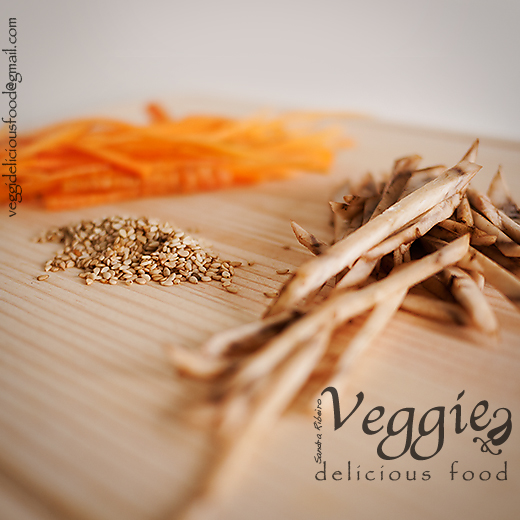
  I have already revealed, in one of the previous posts, how much I appreciate burdock root.   As I have promised, here is some information of what I know about this super root.
  It is rich in calcium, potassium, vitamin C, magnesium, it purifies the blood, it is good for the skin... You name it...
  The first time I ate burdock I felt that my taste buds were into "nirvana". I loved it! But I must confess that here at home, my family, though they like it, they don't share the same passion as I do...

  If you want to try the burdock salad that I prepared, rush to Príncipe Real Bio Market, here in Lisbon, as the last ones are there to sell...


Ingredients:
1/2 burdock root
1 large carrot
1 tbsp sesame oil
1 tbsp sesame seeds
salt to taste


Wash the burdock and remove the skin.
Cut it into thin strips and steam until it is soft but not too much.
Wash the carrot, cut it into strips and steam until slightly soft.
Heat a pan and add the oil. Add the burdock and mix for 2 minutes then add the carrot and combine well.
Add the seeds and season it with salt. Taste and cook for 1 or 2 minutes more.

Bon appétit!

© veggie delicious food, February 2013

Sunday, 10 February 2013

Tofu salad


  The "myth" of salads: enjoyable for some and punishment to others ...

  Certainly almost all of us have witnessed some situations, especially with children (and even adults) that make an ugly face when they see a plate of salad in front of them.
  To avoid these episodes we have to change the routine of our taste,  appreciating certain flavors, usually requires a food re-education and especially the desire to "free" ourselves from the typical routine of portuguese lettuce and tomato salads.
  Traditionally, salads are light and healthy dishes that can be served either on hot or cold days, whether winter or summer. We just need to be receptive to enjoy them, whether in main dishes, side dishes or even when exquisitely designed to celebrate special moments.
The secret is to choose fresh ingredients and combining them with imagination.
  If you are preparing a salad as a main dish, as I suggest here, you should add a protein according to your taste - in this case I used tofu.
  The vegetables should be thoroughly washed and then dried with a clean cloth. When using lettuce, wash it well and then just let it dry in a colander.
  When possible, buy organic vegetables in the markets - Lisbon has already an offer that starts to be reasonable. Generally the vegetables are fresher and cheaper.

  My suggestion today is a tofu salad with mustard sauce. A good sauce makes the difference and opens the appetite of the eyes and of the mouth.
  I tried to get some warm textures and some spicy flavors, so I made a selection of mizuna, arugula and radishes.
  Mizuna is a vegetable from Japan, also known as Japanese mustard. It has a slightly bitter flavor it is very fresh and crunchy. I used young leaves that I bought at the Príncipe Real bio market.
  I love arugula so I use it frequently. I appreciate its texture and the flavor which is slightly bitter and spicy. It is rich in protein, calcium, iron and omega 3, (believe me, proteins are found in many foods besides animal).
  If you are not a fan of these flavors, you can always use other vegetables and keep the base.
  Tofu can also be raw, just marinated in a little soy sauce, grated garlic and a few drops of lemon. If you choose this solution, use silk tofu.


Ingredients:

150 gr tofu cut into thick sticks and left to stand for 1 hour in a vegetable stock with 1 tbsp soy sauce, 1 grated clove garlic clove, 1 tbsp lemon juice, salt to taste
4 small asparagus
Mizuna
arugula
3 radishes
2 black olives cut into slivers
sesame seeds to taste

For the sauce:

4 or 5 tbsp of olive oil
1 tbsp of balsamic vinegar
1 tbsp of dijon mustard
1 tbsp of soy sauce
salt

Grease a pan with a little olive oil or sesame oil and toast the tofu over medium heat on one side and the other until golden. Reserve.
Wash the vegetables and dry them using a clean cloth.
Wash the radishes and cut them finely.
Wash the asparagus, remove the woody parts that are not digestible. Reserve the tip and cut the body of the asparagus into thin strips.
Prepare the sauce by adding all ingredients and check if it needs salt.

  Place the vegetables on platte and put the tofu on the top. Season it with mustard sauce and sprinkle with sesame seeds.

Bon appétit!

© veggie delicious food, February 2013